Showing posts with label hall. Show all posts

Tuesday, May 3, 2011

Palladium pictures, Part II


Today's post is devoted to looks at areas of the Palladium concert hall in Carmel, Ind., outside the main performance hall itself -- the vestibules, halls, rotunda and other gathering areas. Note the marbled floors, elegant stairways and array of colors, patterns, lines and shapes, beginning with the shot leading off the post -- note the lines, colors, shapes, patterns, all packaged into this slightly different perspective.

That's what I was pursuing in these shots, taken Sunday with other members of the Indy Meetup Photo Club, beginning with the "different" perspective shot leading off the post. This, actually, was an accidental shot. My camera had unexpectedly made a left downward swing on the tripod as I was trying to adjust it for a traditional shot of the stairway, and when the camera ended its unaided tilt, it gave me this "look." I was using the 7D's live view feature at that point of my shoot, so I got an instant glimpse at the wall pattern, almost straight on, but it threw the stairway and other things on the right side out of alignment. I liked it immediately.

Most of the shots below need no real explanation; I'll add some where I think it might be helpful. 


Above: This shot in the east rotunda I first captured with the dome squarely in center, and it's a nice shot. Immediately afterward, I noticed the column on the right and did a second shot pushing the dome to the left.
Above and below: This reflective feature rotates its promotions of various upcoming performances. The one above was promoting the June 17 Clint Black show, which is part of the Palladium's country-western series; the one below promotes the "Celebrating Miles" show, a tribute to jazz trumpet great Miles Davis for the jazz series, a show that actually was held the previous night (April 30). Interesting that they would use an illustration of a guitarist for a Miles tribute, no? Sure, there's electric guitar in jazz, but again, Miles was a trumpet player ...


Above and next three below: These are all from the east rotunda. 


Above: The Basile cafe and gift shop off the east rotunda. It was named for Indianapolis philanthropists Frank and Katrina Basile. I liked the range of color, the exit door contrast, and the door window's bright reflective glare on the marble floor.


Above: Simplicity in a glimpse of a table, mirror, a real light (above table), reflected light (in mirror) and a reflection on the shiny table top.


Above: This shot had little to do with the Palladium, but when I noticed how all the elements fell together, I had to grab it. The arched shaped on the left is the dangling camera strap I was trying to steer out of the way, and I believe that is the strap's shadow winding out of the bottom of the picture just to the strap's right. The shadow of the square element in the center of the arched strap belongs to the camera housing on the tripod (the housing would be just out of the picture on the right). You also see two sets of legs here -- the tripod's and mine, with a bonus shadow of one of the tripod legs. The shadow coming off my right pant leg is from the shutter-release cable I have attached to the camera.


Above: To grab this, I was lying supine on the ground and used the live view function of the camera to compose. 


Above and next two below: Carol Baker of the COTPA staff, who greeted and welcomed our group when we arrived, encouraged us to explore the restrooms because of the tiling, and this is why -- the keyboard (ceiling) and treble clefs (floor) illustrations. The third shot is nothing about tiling; it's just about the nifty marbletop counters and shiny silver plumbing hardware. Oh wait, I spoke too soon! Look closely on the counter top and counter side panels, and what do you see? By gosh, it's the reflections of both the keyboards and the treble clefs!


Thursday, October 21, 2010

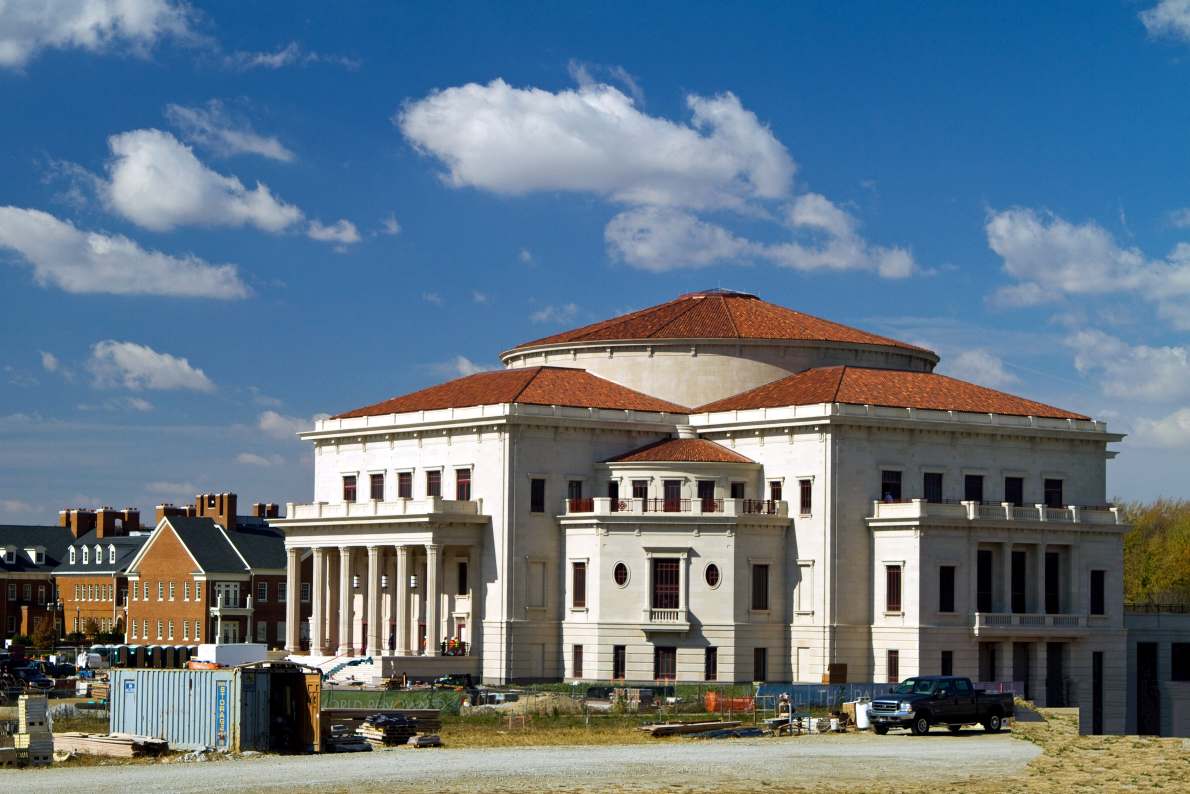
Palladium adds the crown jewel to burgeoning Carmel landscape


I'm sure every metropolitan area in the country has its suburban communities where the affluent gravitate and, which then become butts of jokes and jabs of elitism by those who are much less well off. When I moved to Indianapolis some 30 years ago, I quickly found that community to be Carmel, located immediately north of Marion County which, under the Uni-Gov legislation adopted in 1970, is essentially the same as Indianapolis.

I had been to Carmel only a handful of times in those three decades, and none for more than destination-only trips. In the past few years, I've been reading with interest how Carmel was doing some progressive things, albeit some with great controversy. Among them have been the nurturing of an office building and medical facility corridor along North Meridian Street on the west fringe of Carmel's original city limits; annexation and development of large chunks of unincorporated Clay Township territory to the west of the aforementioned corridor; the transformation of its older, downtown merchants district into what it calls the Arts & Design District, a destination point for shoppers, art lovers and tourists alike; the building of dozens of roundabouts at key intersections (including -- and especially -- the extremely heavily traveled Keystone Avenue) to facilitate and better funnel a growing amount of traffic; and the development of several city parks, such as the distinctive Coxhall Gardens in the more sparsely populated area of western Clay Township that was part of one of the annexations. The Carmel Clay school system has kept pace, adding and improving facilities to match the community's growing attraction and population.

All of these would be impressive on their own to anyone, anywhere. Yet there is more: The Palladium, a regional performing arts center and the crown jewel of what Carmel is calling its fine arts-driven City Center, a mixed-use development that includes 300 apartments and penthouses, restaurants and an upscale 102-room hotel, and the Freedom Circle Plaza, which includes the Carmel Clay Veterans Memorial Statue and reflecting pond. The Palladium, which will seat 1,600 in its main hall, also will feature a 500-seat proscenium theater, a 200-seat studio theater and an outdoor amphitheater. 

Even before its scheduled January 2011 opening, the Palladium has fetched quite a few plaudits as a top concert venue in the country by experts who've reviewed the structure's construction and acoustic specs. To handle the job of center artistic director, the city retained Michael Feinstein, an American singer, pianist, multiplatinum-selling and five-time Grammy-nominated entertainer. Feinstein's Great American Songbook collection -- featuring compositions of music, lyrics and history created by great 20th-century artists such as George Gershwin, Irving Berlin, Jerome Kern, Cole Porter, Harold Arlen, Rodgers and Hart and many others -- will be housed at the center. 

The center will be home to a number of performance art groups. Taking up immediate residence upon the January opening will be the Civic Theatre, which will be the center's principal resident theater company, and the Carmel Symphony Orchestra. In the future, they will be joined by Carmel's Actors Theatre of Indiana; Carmel Repertory Theatre; Central Indiana Dance Ensemble, Gregory Hancock Dance Theatre and the Indiana Wind Symphony. The Indianapolis Symphony Orchestra plans to make periodic visits there. 

The building's design -- that's all Indiana limestone on the exterior, by the way -- was inspired by a villa designed by Andrea Palladio. Built in the 1500's near Vicenza, Italy, the villa, known as "La Rotunda,” remains an architectural icon nearly 500 years later. While not specifically named for the famed architect, The Palladium, nevertheless, represents an important homage to his work.

All of this is to preface the fact that I finally made a photo shoot jaunt to Carmel to capture some of what is happening there. Today, I present images of the Palladium (sadly, none of the interior) taken during my shoot. I got as close to the structure as I was allowed; it's still part of a construction zone. The shots include some architectural detail and a shot of the Palladium (top) that I don't think I've seen anywhere yet. The image features, on the right, the 9-foot bronze Veterans Memorial statue (by Indiana sculptor Bill Wolfe) that serves as the centerpiece of Freedom Circle Plaza, which is west of the Palladium. The statue depicts a kneeling male soldier and a standing female soldier raising the flag after battle. In my photo, the angle shows the left hand of the male soldier hovering over the Palladium in a sort of gesture of protection and comfort. Ahh ... the benefits of a wide-angle lens! If you wonder why the blue in the sky color looks a bit different in some similar-angle shots, it's because I used a polarizing filter for some of the images. Images with the crisp blue sky (like the one at the top) were taken using that filter.

My Carmel shoot encompassed about six hours on a recent morning and afternoon and included visits to the City Center, the Arts & Design District and Coxhall Gardens. I'll be offering more glimpses of Freedom Circle Plaza and the statue, the Arts & Design District and Coxhall Gardens in Photo Potpourri in the days and weeks ahead when time allows. At some point, too, I'll organize the images into a gallery at my online site and provide a link to that when the gallery is ready. In the meantime, enjoy ...